The next act is yours to define.

Reference comes before preference.
The Cadillac of…
Everybody knows what that means.
Cadillac achieved something extraordinary. It became so synonymous with luxury that, decades later, its name is still shorthand for the finest version of almost anything.
That didn't make Cadillac the car for everyone. If safety, space or ruggedness mattered most, other brands might have the advantage. But if luxury or prestige was your priority, Cadillac had already helped define what you were looking for. And if you hadn't yet decided what mattered, Cadillac had an answer for that, too.
And here's the real magic trick: Cadillac was never even the most luxurious car. Bentley was more luxurious. Other manufacturers almost certainly built better cars.
But none of them became the Cadillac of anything.
The opportunity is way upstream.
Most organizations concentrate their ingenuity on winning demand after the market has already decided what matters. The advantage lies in helping shape that understanding while it is still being formed.
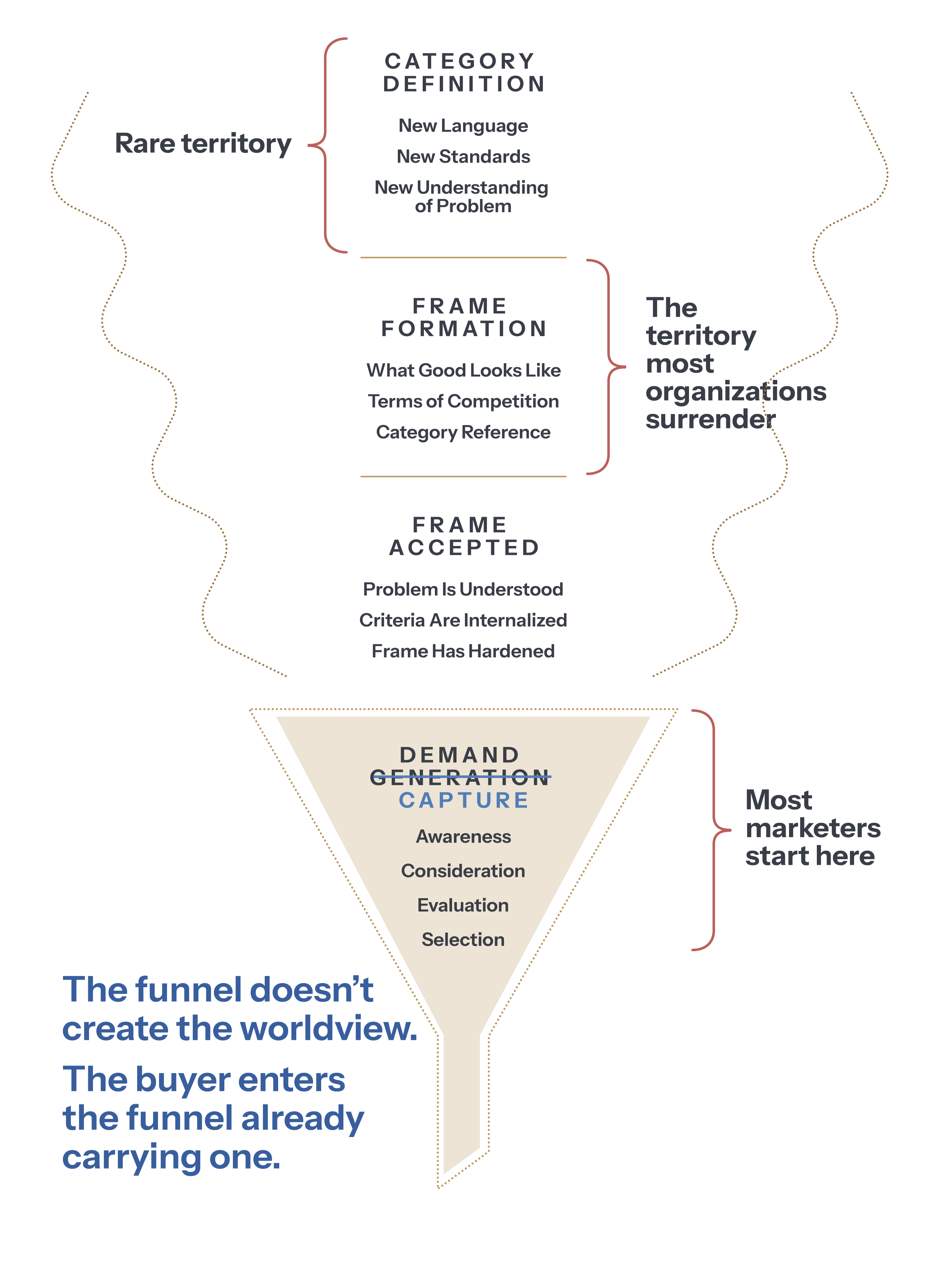
Belief becomes advantage.
Most organizations have no difficulty investing in the first layer of brand: organizational identity. Purpose, mission, vision, values. Nor do they lack enthusiasm for the sixth: market expression. Content, campaigns, conferences, websites, sales enablement, AEO and all the machinery of go-to-market.
But between those two lie the four layers that so often go missing — the connective tissue that turns belief into decisions, decisions into coherence, and coherence into competitive authority.
The Enterprise Value Stack
Each layer represents something the organization must be able to articulate and own for itself.
Organizational Identity. Who we are, why we exist, and what we stand for.
Category Worldview. What we believe about this entire space — not just ourselves or our competitors — and where it's going.
Reference Ambition. What we intend to become the reference for.
Authority Territories. The enduring questions and conversations through which we will repeatedly demonstrate and earn that authority.
Narrative Architecture. How that worldview becomes intelligible and consistent across leadership, products, acquisitions, expertise, and every expression of the business.
Market Expression. How those commitments become visible in what we build, do, say, and deliver.
A company can develop excellent products, make sound investments and pursue profitable opportunities while leaving it to competitors to decide what matters in the category. Brand strategy brings that question back into the business, where it belongs: what should the market value, and what must we build, do, and prove to become the reference for it?
From provider to category reference.
What's missing in most categories — especially complex, technical, or considered-purchase environments — isn't another credible, proven, trusted solution to the problem everyone else is also credibly, provenly, and trustedly solving. What's missing is a reference: a brand that has earned the authority to say what good looks like — and demonstrated it so completely, at every level of the customer organization, that the demonstration itself becomes the standard.
A vendor answers the question. A partner helps solve the problem behind it. An authority helps the market understand what it should be asking next.
The ambition is to become a value orchestrator: a brand whose authority shapes how value is understood across the customer organization, well beyond the people purchasing or using its products. Because sponsors, skeptics and senior executives can determine who makes the shortlist, whether or not they appear in the CRM.
Every execution has two jobs.
A sales sheet should help sell. A product announcement should explain what's new. A campaign should drive awareness, interest or action. That's the job immediately in front of it, and it should do it well.
But every execution has a second job: to reinforce the ideas the organization has chosen to own, and thereby accrue authority over time. One execution, two time horizons. The immediate result, and the cumulative contribution to what the business is becoming known for.
The point isn't to invent a new big idea for every campaign, website or product launch. It's to establish a consequential point of view early enough, and believe in it strongly enough, that the organization can keep putting it to work. The strategy should evolve as the business learns. It shouldn't be renegotiated every time somebody needs a new piece of marketing.
When those beliefs are genuinely shared, marketing, sales, product, customer success, executives and agency partners can each do different things without telling different stories.
Creating the standard makes you the reference. The reference earns the authority to set the next standard. And so it compounds.