

In the works.

Everybody Move Over One!
It's 2009. My agency and every other hotshot specialist digital agency in the world are lobbying our top clients for a seat at the "strategy" table. Little did we know, it was already starting to disappear under our data-sniffing noses.
Twenty-Three Agencies Walk Into Your Office…
It was 2009, and we'd just won Canadian Tire's paid-search business. I was the president of DAC Group Digital and, having convinced the client we were the best at paid search, we immediately set about persuading her that we were also awesome at strategy. Couldn't we be permitted to do some of that, too?
By way of an answer, the corporation’s AVP of the moment — CanTire seemed to be going through them like Kleenex at the time — told me she had twenty-three digital agencies. Twenty-three! One for paid search, another for organic search, others for email, coupons, the website, and so forth. I'm sure every one of us was asking for a seat at the strategy table, too. She might have been feeling a little besieged.
She said, she knew the right answer wasn't twenty-three. But she also knew it wasn't one.
I remember that conversation because the number was absurd. Twenty-three agencies, each with its own specific channel expertise and its own good reasons for being entrusted with more of the client's business.
It sounded ridiculous then, and it sounds ridiculous 17 years later — although, what is HubSpot, if not a stack of 23 virtual channel partners? — but of course there was nothing ridiculous about how we got there.
The Internet Broke Everything
For much of the previous century, the agency-of-record model had been a reasonably straightforward proposition. A company would entrust a significant part of its advertising business to an agency that was expected to understand its products, customers, competitors and market well enough to develop campaigns that made some sort of strategic sense.
The arrangement had its problems. Agencies were expensive, territorial, frequently arrogant and sometimes astonishingly confident about subjects they knew next to nothing about. But there was at least an expectation that somebody on the agency side understood the client's business as a whole, and that somebody was expected to have an opinion about where it should go. It wasn't necessarily a very good opinion, but it was an opinion informed by more than one advertising channel.
Then the internet came along and blew the model to pieces. Suddenly there were websites to build, search engines to master, databases to manage, email programs to develop, ecommerce platforms to operate, and an ever-expanding collection of new ways for customers to discover, investigate, evaluate and buy things.
The traditional agencies weren't equipped for all this. How could they be? These weren't simply new places to put advertisements. They were new technologies, new disciplines, new ways of doing business. Some required skills that had little in common with anything an advertising agency had previously employed people to do.
So the industry specialized. New agencies sprang up around search, websites, email, social media, analytics and whatever else the internet had invented that week. The big agency groups bought specialist firms and assembled portfolios of capabilities, while independent agencies built businesses around expertise that the established players didn't yet possess. I spent a substantial part of my career helping build precisely those businesses. And I'd do it again.
The new capabilities were extraordinary. We could reach customers in ways that had previously been impossible, understand aspects of their behaviour that had been largely invisible, and make changes to our marketing based on what people actually did rather than what we hoped they might do. Clients needed this expertise, and they were perfectly right to go looking for it.
But every new specialist came with a new relationship to manage, another budget to allocate, another set of objectives to establish and another performance report to review. The agency world was fragmenting, and marketing departments were having to reorganize themselves to accommodate it. An email specialist needed someone on the client side who understood email. The search agency needed someone who understood search. The website people needed someone to make decisions about the website. The resulting organizational structure was beginning to look remarkably like the agency roster that had produced it.
Meanwhile, each specialist had a perfectly legitimate claim to strategic relevance. Search agencies knew what customers were looking for. Website specialists knew what they did when they arrived. Email marketers knew how they responded to offers. Analytics people knew which activities appeared to be working. If you possessed that kind of intelligence, wouldn't you want to bring it to the strategic conversation? Of course you would. We certainly did.
And the client would be a fool not to listen. The problem was that each of us had a particular view of the business, shaped by our expertise and, inevitably, by our commercial interests. We weren't necessarily wrong about anything. But we were each looking at the business through a different lens, and we had a vested interest in persuading the client that our window offered the best view.
The client, meanwhile, was expected to make sense of the whole landscape. Twenty-three agencies, twenty-three angles, twenty-three ‘strategic’ analyses.
But We Have METRICS!
My first love was theatre, and my first career was sketch and improv comedy. Copywriting came later, followed by creative direction, digital, marketing, and the curious business of making increasingly sophisticated systems perform.
I've worked on the creative side, inside brands, and spent much of my career building and leading digital and performance-marketing businesses across countries and markets.
I mention this because I was hardly an innocent bystander in the digital revolution. I was one of its evangelists. At DAC Group, I spearheaded the transformation of an old-school directory-media brokerage into a leading independent digital performance agency. I believed in the value of specialization and technology, and I still do. But I'd also spent years making advertising before the internet, and that made the possibilities all the more exciting.
In the old days, we weren't flying blind. We had audience research, tracking studies, sales figures and brand-awareness surveys. What we couldn't see was much of what happened between someone encountering an advertisement and deciding what to do about it. So we drew inferences, sometimes based on years of research and experience, often on much less, delivered with enough confidence to compensate for the lack of evidence.
Then came ‘interactive’ media, aka digital, and we could watch people doing things. Someone saw an ad, clicked on it, visited a website, looked at a product and sometimes bought it. We could follow that trail, or parts of it, and show the client the numbers. In retrospect, we were probably getting a bit high on all this statistical tracking — or what they called on the street: ‘measurability.’
After all, tracking an activity isn't the same as measuring its contribution, and neither proves what caused the result. In certain moments of sober reflection, I believe we understood that distinction. But after years of making advertising without being able to see what happened next, the ability to follow where people clicked was extraordinary.
Better still, we could adjust things and see what changed. Test a message, tweak the targeting, swap out an offer, shuffle up a landing page, move some budget around. Sometimes we could see the results within hours, rather than waiting weeks or months to find out whether a campaign had worked. We were learning as we went, and getting better at it.
And taking those results to a client was immensely satisfying. You didn't need a big creative department, fancy offices or an agency relationship stretching back three generations. You could show exactly what you'd delivered — “dollars in, dollars out” these weren’t opinions anymore. We had… data.
Somewhere in all that excitement, a new assumption was forming: if something could be measured, naturally it should be. It only made sense. If tracking helped show how we were ‘moving the needle,’ why wouldn't we track everything in sight? As the infamous quote from Peter Drucker goes, “what gets measured gets managed” — right?
Actually, Drucker never said that. And the rest of the quote, which is never mentioned, will knock you off your performance chair.
A Seat at the Table? What Table?
Nobody ever set out to collect scores of agencies. The internet had given marketing a whole new set of levers to pull, and each needed an expert. So companies hired specialists, then more specialists to manage the specialists. Eventually all those exotic new disciplines became just marketing again, only now with a bewildering number of levers.
Of course, we needed something besides an army of AVPs to manage this complicated ‘new’ marketing mix. And Martech would soon step in to save the day, but that’s part of the NEXT problem. Because while we were busily automating campaigns and reporting our now thrillingly measurable performance by ‘granular’ channel, tool and tactic, nobody checked the trunk to see if we’d packed the strategy table.
But I'm getting ahead of myself. In 2009, we had Omniture, Urchin, and the beginnings of marketing automation. The great martech machinery was still taking shape, and twenty-three agencies were clamouring for a seat at what was presumably an average-sized table.
We had no idea it was already starting to disappear.

Why SYMBION? Take Two.
Marketing has never had more tools, more data or more ways to perform. So where did the strategic thinking go? A conference in Boston, a missing strategy table, and a second meaning I've discovered in a phrase that's been part of SYMBION since the beginning: performative thinking.
The name stuck. The blog, less so. A dozen years later, SYMBION is still here, although quite a lot has changed in what I do, how I do it and, especially, what I think about it all.
I just got back from Boston, where I attended the MarketingProfs B2B Forum for the fifth year running. I love this conference, although each year I seem to attend fewer of the sessions. Typically, about half the program is devoted to practical workshops on marketing automation, demand generation, content production and how to execute all that stuff better, faster and more efficiently.
I've spent a good part of my career building and running digital marketing businesses, so I'm hardly dismissive of any of it. But these days I increasingly want to do less and talk more, so I tend to skip the hands-on workshops and concentrate on the bigger conversations.
This year, though, practical learning seemed to account for something like 85% of the program. And AI was in every session title: How to use AI to produce more content, automate more processes, personalize more campaigns, get more done with fewer people. In session after session, marketers were learning how to use technology that promised to make them dramatically more productive, while trying to figure out whether it was also going to make their jobs disappear.
You could practically see the burnout happening in real time. And amid all the advice about doing more, faster, the recurring prescription was to be more human. Be authentic. Exercise judgment. Bring something to the job that AI can't.
One speaker offered an example that pretty much summed it up: A CEO sends marketing a thought-leadership white paper, complete with a point of view, written on their behalf by Claude. The accompanying instructions are to "work your magic" and get it out into the market. Except the CEO hasn't read it. Nobody else in the company has developed or agreed with the point of view. And somewhere, their competitors are probably using Claude to write essentially the same paper.
So now marketing gets to make it sound authentic.
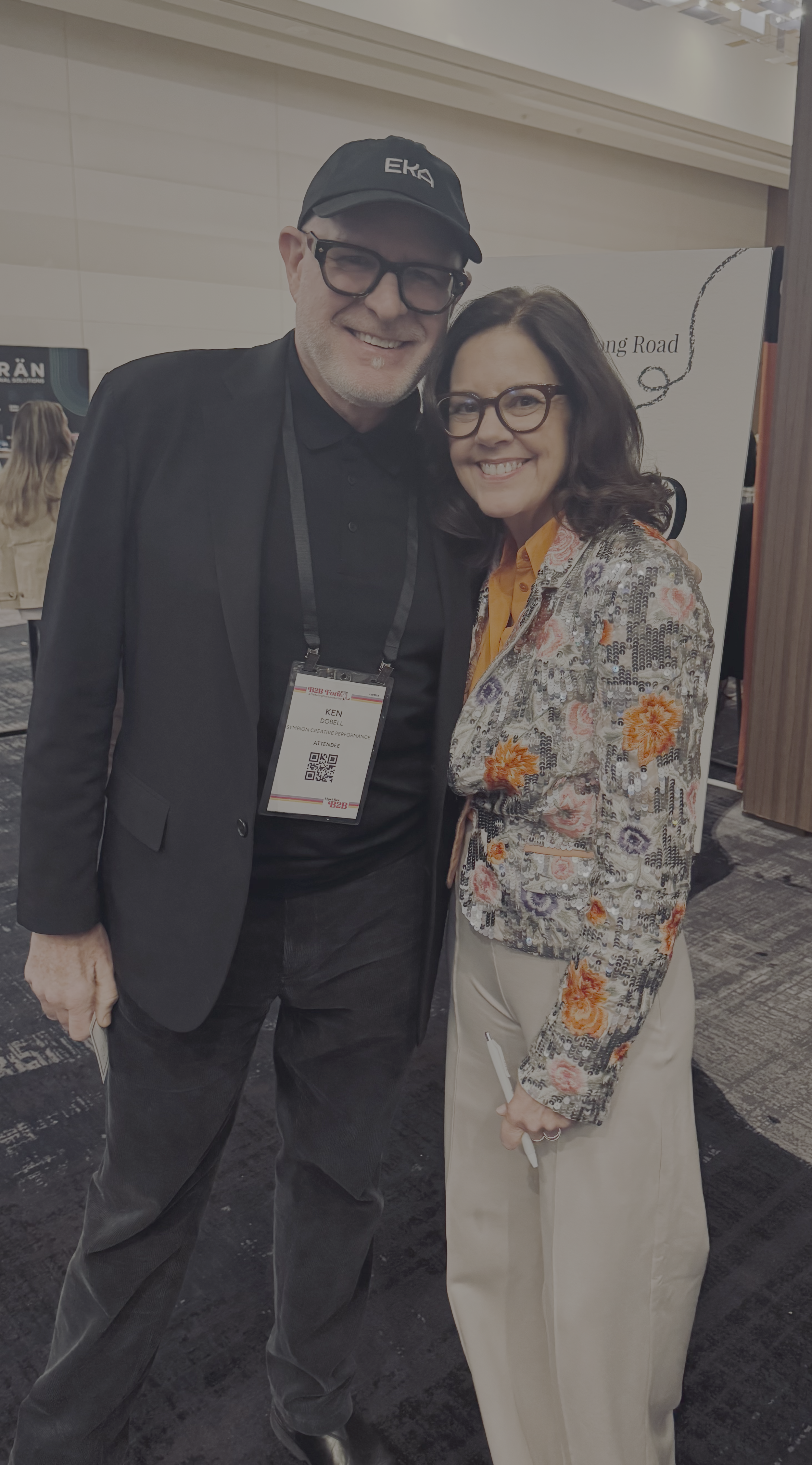
With MarketingProfs' Chief Content Officer Ann Handley at the B2B Forum, Boston, November 2026.
Meanwhile, in the remaining 15% of the conference, the old folks were having a different conversation.
Rory Sutherland, President Emeritus of Ogilvy Consulting, gave a terrific keynote about how marketing used to concern itself with all four Ps: product, price, place and promotion. We've managed to surrender the first three — and much of what remains of promotion, especially in B2B, has become sales enablement. I’ve come to almost exactly the same conclusion myself.
Michael Barber, until recently Startech’s CMO, made the point that AI is getting good at doing our jobs precisely because we've made them so robotic. Yes! He went on to proclaim that, if we want to remain relevant, we need to reclaim marketing's strategic role. Get back into conversations about the business. Demand a seat at the table. Demonstrate to the CEO and executive team that marketing has something more valuable to contribute than increasingly efficient promotion.
Amen to that! I've been saying the same thing for years. There’s just one problem. I went up to Michael after his talk and said, "Dude. What table? Who are you going to have these conversations with?" Because that's the thing. In far too many organizations, there’s no ‘strategy’ table on some high floor, with an empty chair for marketing. The table's gone.
It's a leaderboard now.
Sales has its numbers. Product has its roadmap. Finance has its targets. Marketing has its campaigns, conversion rates and attribution reports. Everyone has a job to do, a set of metrics to improve and an increasingly sophisticated collection of tools to help them do it.
The company can be hitting its targets, shipping products, generating leads and reporting record performance while the people running it have entirely different ideas about what the business is becoming, what it believes or why anyone should prefer it to the competition.
As long as the dials are moving up and to the right, do more. If not, do more faster. The organization is built to do what it can measure and optimize.
Practitioners are trying to survive a system that's automating their jobs, while veterans are demanding a return to strategic conversations that companies are no longer structured to have. And AI has made the whole absurdity impossible to ignore.
AI didn't create the problem, and it won't solve it. Decades of specialization, technology and performance management have brought us to a point where organizations are extraordinarily good at performing, and increasingly bad at thinking.
I've been circling this problem for a long time, both in my own practice and in the work I do with clients. More and more, I find myself asking questions that precede the marketing plan, the product roadmap and, sometimes, the corporate strategy itself. What do the people running this company believe about its category? Where do they think it's going? What do they intend to change? And would they all give you the same answers?
Either you're doing it wrong — or you don't know what you're doing. And almost nobody is doing it all wrong.
If you've hit a commercial wall and you think the answer is a better website or new messaging, I’m looking at you.
Performative thinking. Take two.
I've been working through these ideas with clients for years. Boston didn't change my thinking, but it convinced me I needed to take the conversation further.
So I've finally brought the SYMBION website up to date. After years of working on other people's brands, my own had become a perfect illustration of why the cobbler's children go barefoot. The site now reflects where my practice has evolved. It's a manifesto for what I believe brand and marketing strategy should do:
Change how organizations compete.
Since I first launched SYMBION, I've been using the phrase performative thinking — meaning, thinking that predicts better performance. I still have physical business cards billing me as a Performative Thinker. But I've come to hear another meaning in the words: the performance of thinking, without necessarily doing any. That contradiction is at the heart of the book I'm writing — you guessed it — Performative Thinking: How the Strategy Table Became a Leaderboard.
And there. I've announced it. Now I have to finish the damn manuscript.
I've disinterred my blog, too. There are plenty more assumptions to challenge, absurdities to expose and ideas to explore than will fit on the website. Some will find their way into the book. Others may be better argued about here.
I'm saving the world, one dysfunctional brand architecture at a time.
#Updated November 27, 2026: Why SYMBION? Take Two.